Please compare the acting styles of Richard Burton and Laurence Olivier featured in the following two clips:
http://www.youtube.com/watch?v=rGEbCemKatY
http://www.youtube.com/watch?v=lsrOXAY1arg&feature=fvw
Thursday, May 6, 2010

Wednesday, May 5, 2010
My Museum Report
On my visit to the Metropolitan Museum I was overwhelmed with the vast amount of art work and sculptures to choose from. I eventually was able to find some interesting things in the Medieval period exhibit. There were a few paintings and sculptures of the virgin Mary and baby Jesus which I found particularly interesting, "Virgin and Child" being one of them. The Medieval period was highly influenced by the Catholic church and as a person whose always found the history of religion to be fascinating I was blown away with the amount of attention they gave to virgin and child.

This picture to me sums up the medieval world. This was one of many sculptures of the virgin Mary and baby Jesus. This was also my favorite sculpture because of the great amount of detail in the piece.


These are some other "virgin and child" pieces.

I was also intrigued by this piece of the mourners who march around the tomb John the Fearless, who fought in the battle of Nicopolis. I found it interesting how different mourners had different expressions.
At the start of the semester, the thought of going to the museum seemed like a chore to me. I didn't think I would enjoy it, much less love it and plan on going back. Reading Dante's Inferno sealed the deal for me and piqued my interest in learning more about the Medieval period. Even though the Hell we see in the Inferno wasn't something I wanted to see further, the world that the poet Dante lived in to write the Inferno was something I was interested in. I wanted to know what would inspire a man and what type of world (political, social, etc.) would that man have lived in to write such a piece. I felt that visiting the Metropolitan Museum of Art helped me better understand that.

This picture to me sums up the medieval world. This was one of many sculptures of the virgin Mary and baby Jesus. This was also my favorite sculpture because of the great amount of detail in the piece.


These are some other "virgin and child" pieces.

I was also intrigued by this piece of the mourners who march around the tomb John the Fearless, who fought in the battle of Nicopolis. I found it interesting how different mourners had different expressions.
At the start of the semester, the thought of going to the museum seemed like a chore to me. I didn't think I would enjoy it, much less love it and plan on going back. Reading Dante's Inferno sealed the deal for me and piqued my interest in learning more about the Medieval period. Even though the Hell we see in the Inferno wasn't something I wanted to see further, the world that the poet Dante lived in to write the Inferno was something I was interested in. I wanted to know what would inspire a man and what type of world (political, social, etc.) would that man have lived in to write such a piece. I felt that visiting the Metropolitan Museum of Art helped me better understand that.
Tuesday, May 4, 2010
My Museum Report
Just like Ying Lee this was my second visit to the Metropolitan Museum of Art. My last visit was for an awards ceremony many years ago. During my visit I was on the hunt for items from the Italian Renaissance period, which basically ran from the early 1400’s to the late 1600’s. I personally selected this period because I believe it is this period that has most influenced the modernization of the world we know today, and in my opinion this period produced some of the greatest artifacts.
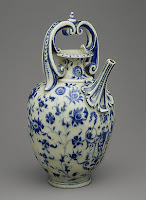

The above photo represents a piece of Medici porcelain. I found this piece truly exceptional due to it’s rarity, and felt that it could relate to our in class discussion of the Medici family and the vast contributions they made to Italian culture.

This is the Farnese Table; it was created by Giacomo Barozzi da Vignola for the Palazzo Farnese, which is an Italian Renaissance palace in Rome. This piece is extremely different because it has a floral pattern created using alabaster, a material that is extremely common in Asian designs.

This is a Renaissance Pharmacy Jar. Pretty Amazing when you compare it to the common pill bottle of today.

This is the papal ring of Pope Paul II, who served as pope from 1464-1471, This ring is extremely interesting for many reasons. From my own jewelry manufacturing experience, the hand cobbling under the nameplate could have take hundred of hours to create. The artistry is amazing, but this ring has another amazing story. It once was in the hands of Bernard Baruch.
My trip to the MET proved to be a great experience as I was able to connect in class lessons with what I was viewing. It was these connections that allowed me to write my report so fluidly.
David Zaremba
Jude Law on Hamlet
Please watch and comment:
http://www.youtube.com/watch?v=kP0fEcDSO2k&feature=related
http://www.youtube.com/watch?v=kP0fEcDSO2k&feature=related
Monday, May 3, 2010
Museum Report
 The more we know, the more we can see or look into something.
This is what I felt when I went to the Metropolitan Museum of Art on the last weekend because I happend to see the painting of "The Death of Socrates" that we went over together at the class. It reminded me the context of the literature and professor's explanation about the painting.
However, at this time, I focused on paintings and sculptures made in the period of the Renaissance because William Shakespeare's most famous work, Hamlet, that we will read was written during the period and it is possible that ideologies of the Renaissance affected Shakespeare's works. The core of the Renaissance is humanism. It brought substantial changes to the European society and differenciated ideas of art from the medieval age.
 The first work that I saw is a sculpture named "La Crainte des Traits de l'Amour" by Jean-Louis Lemoyne. According to the explanation from the museum, this statute looks like "the woman is self-protecting as Cupid suddenly appears." It seems that its sculptor tried to describe the moment as realistically as possible and wanted to express the sophisticated bodylines, which is one of characteristics of the Renaissance.
 The first work that I saw is a sculpture named "La Crainte des Traits de l'Amour" by Jean-Louis Lemoyne. According to the explanation from the museum, this statute looks like "the woman is self-protecting as Cupid suddenly appears." It seems that its sculptor tried to describe the moment as realistically as possible and wanted to express the sophisticated bodylines, which is one of characteristics of the Renaissance.
 The folloing painting is a work made in mid-16 century. It was drawn by oil on wood and is portraying images of French aristocrats of the Renaissance. We can notice here how vividly its artist is expressing each figures and their splendid clothes. The other two pictures are accessaries of the Renaissance. The lighters and ornaments made by gold clearly shows how the life of aristocrats in England for the period of the Renaissance looks like.


Although I could not find any works that directly relate to William Shakespeare's Hamlet, it was such a good opportunity to know social circumstances of the Renaissance in order to funther understand his work.
Reference
The Chinese World, Tu Fu’s World, and My World
This was my second time to the museum. Last time I went there was two years ago I was visiting the paintings which were Van Gogh’s works. He is my favors artiest. However, this time I went to visit the museum because I was curious of how American people viewed Chinese culture.
When I went into the Chinese exhibition, I could see and feel that I went back to the place where I grow up.
When I went into the Chinese exhibition, I could see and feel that I went back to the place where I grow up.
 This picture is about the “Cursive hand”. Some people also called it “Grass hand” or “Grass style”. In Chinese, it pronounces “cao shū.” The real meaning of “Cursive hand” is simple writing. You can see from the picture that most of the words were done by one or two lines. They were so beautiful.

This picture is about the housing style of Tang dynasty. Tu Fu was a poor student. Can you image that Tu Fu was sitting on this chair and studying very hard during the snow days and hot summer nights through many years? If that was me, I could only sit ten minutes. I like sofa more….
 This picture is about the tool of penmanship which include Chinese writing brush and ink-stone. Penmanship is one kind of art. When I was second grade, our teacher asked students to write penmanship. It is very difficult to write. That is the only thing that I understand about penmanship. However, Tu Fu wrote thousands of poetries using penmanship that were incredible.
I was sitting in the garden and watching people who came to see Chinese cultures. They were very quite. Did they feel the ambience of studying of that time?
Museum Project
Dante Alighieri's Divine Comedy (specifically Inferno) and the Medieval Period was an obvious choice for my Museum Report because of the symbolism and many allusions made in the story. Although this was my first time reading any of the Divine Comedy, or Dante for that matter, the reputation it has had in Western culture and its impact on art has made the poem legendary.
Although it was difficult to find specifically relative pieces of art during my visit to the museum, I did stumble on a few interesting pieces that made me think 'Dante.'

After being led around different ways by the Museum staff, I ended up finding a painting by Giotto di Bondone. One of the members of the Met staff that I had asked for help, told me that I should look for Giotto because Giotto happened to be a friend of Dante's. In fact, the description next to the painting claims that Giotto was 'praised by Dante' and was considered the 'most famous artist of his day.' As a contemporary to Dante and a fellow Florentine, Giotto's paintings, is apparently religious. The specific piece's subject matter (The Epiphany), is the Nativity scene, but it is part of a collection that includes several scenes of Jesus' life.
Giotto had also painted a portrait of Dante himself, although I did not see this particular painting at the Met. Unfortunately, Giotto's painting did not stand out to me among the rest of the Medieval Art. I found it to be ordinary among the 100's of painting of Jesus surrounding it.

What I had stumbled upon next was not of the Medieval period, but from 16th century France. Although not being part of Dante's time, this piece of a set of enamel paintings illustrate scenes from the Aeneid. I took a picture of this enamel in particular because it contained the scene of the Aeneid where Aeneas is leaving Carthage and Dido is pictured watching him.
Dante includes Dido, lover of Aeneas, in his second circle of the inferno(lust) as a part of his 5th canto.

Although I had found a few other pieces of the Medieval period of Dante, I did not find anything that had particularly interested. But while reading Dante's 33rd Canto of the Inferno, which takes place on the ice of the 9th Circle of Hell(just before Lucifer,) I noticed a familiar name. There in the 9th circle laid Ugolino and Ruggieri were suffering, frozen in ice, punished for political treachery.
Ugolino had been the particular name that I recognized and it reminded me of a past trip I had made to the Met, when I was taken away by 19th century sculpture by Jean-Baptiste Carpeaux. The huge sculpture depicts Ugolino's earthly punishment, being locked in a room to starve with 2 of his sons and 2 of his grandsons. Before starving to death, Ugolino is tormented by the fact that his sons plead for him to eat their own bodies.
I had expected to find more art influenced by Dante or at least Medieval art that I found interesting. Unfortunately, I found the art of Dante's time to be quite dull, but art such as Carpeaux's Ugolino and his sons far more interesting.
By the way: I found a really cool site recently with summaries' of Dante's Divine Comedy, accompanied by some explanations and illustrations.
http://danteworlds.laits.utexas.edu/
Although it was difficult to find specifically relative pieces of art during my visit to the museum, I did stumble on a few interesting pieces that made me think 'Dante.'

After being led around different ways by the Museum staff, I ended up finding a painting by Giotto di Bondone. One of the members of the Met staff that I had asked for help, told me that I should look for Giotto because Giotto happened to be a friend of Dante's. In fact, the description next to the painting claims that Giotto was 'praised by Dante' and was considered the 'most famous artist of his day.' As a contemporary to Dante and a fellow Florentine, Giotto's paintings, is apparently religious. The specific piece's subject matter (The Epiphany), is the Nativity scene, but it is part of a collection that includes several scenes of Jesus' life.
Giotto had also painted a portrait of Dante himself, although I did not see this particular painting at the Met. Unfortunately, Giotto's painting did not stand out to me among the rest of the Medieval Art. I found it to be ordinary among the 100's of painting of Jesus surrounding it.

What I had stumbled upon next was not of the Medieval period, but from 16th century France. Although not being part of Dante's time, this piece of a set of enamel paintings illustrate scenes from the Aeneid. I took a picture of this enamel in particular because it contained the scene of the Aeneid where Aeneas is leaving Carthage and Dido is pictured watching him.
Dante includes Dido, lover of Aeneas, in his second circle of the inferno(lust) as a part of his 5th canto.

Although I had found a few other pieces of the Medieval period of Dante, I did not find anything that had particularly interested. But while reading Dante's 33rd Canto of the Inferno, which takes place on the ice of the 9th Circle of Hell(just before Lucifer,) I noticed a familiar name. There in the 9th circle laid Ugolino and Ruggieri were suffering, frozen in ice, punished for political treachery.
Ugolino had been the particular name that I recognized and it reminded me of a past trip I had made to the Met, when I was taken away by 19th century sculpture by Jean-Baptiste Carpeaux. The huge sculpture depicts Ugolino's earthly punishment, being locked in a room to starve with 2 of his sons and 2 of his grandsons. Before starving to death, Ugolino is tormented by the fact that his sons plead for him to eat their own bodies.
I had expected to find more art influenced by Dante or at least Medieval art that I found interesting. Unfortunately, I found the art of Dante's time to be quite dull, but art such as Carpeaux's Ugolino and his sons far more interesting.
By the way: I found a really cool site recently with summaries' of Dante's Divine Comedy, accompanied by some explanations and illustrations.
http://danteworlds.laits.utexas.edu/
Subscribe to:
Posts (Atom)